
Bedrock
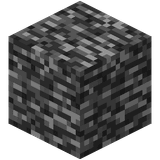
Bedrock is a block in Minecraft.
Bedrock is the block the world is built against — an unbreakable frame that floors the Overworld, floors and roofs the Nether, and anchors the structures of the End. No tool mines it, no explosion dents it, and no piston moves it, so every question about how to break bedrock in survival ends the same way: you cannot. The methods that claim otherwise are glitches, not mechanics, and they stop working as soon as they are patched.
That indestructibility is load-bearing for the shape of the world. The layer at the bottom of the Overworld is what stops you digging out of it, and because its underside is ragged rather than flat, the lowest usable floor shifts by a block or two as you walk. In the Nether the same block forms a solid ceiling at Y 127, and the perfectly level plain on top of that ceiling is the Nether roof — the flat expanse that every long-distance Nether travel debate is really about.
In the End it does structural work instead. Bedrock frames the exit portal and every End gateway, and it is one of the only surfaces an end crystal can be placed on, which is what makes respawning the Ender Dragon possible. Fire lit on top of it in the End never burns out, the same eternal flame netherrack gives you.
Builders reach for it when nothing else survives. A wither sealed inside a bedrock box cannot blast its way out, which is the standard way to farm one safely, and a note block sitting on bedrock plays the bass drum voice. The block itself has no item form you can obtain in survival — only the creative inventory or commands place it — but the tricks stay available wherever the world provides bedrock ready-made, which is why wither fights are staged against the End’s exit portal or the Nether roof.
