
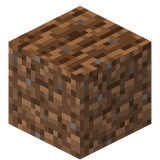
Farmland
Farmland is a block in Minecraft. It can be mined and collected.
Farmland is what dirt becomes when you hit it with a hoe, and the surface every seed crop has to be planted in. Tilling grass, dirt, or a dirt path is the whole of how to make farmland, and you cannot pick the block back up: breaking it just hands you plain dirt again.
Water is what makes it work. A source block within four blocks horizontally, on the same level or one above, keeps the soil dark and wet, and hydrated farmland grows crops noticeably faster than dry soil does. Dry, unplanted farmland reverts to dirt on its own after a while. That four-block reach is the single geometric fact behind almost every farmland design ever built: a nine-by-nine plot with one water source at the center wets every tile, and tiling that unit is why a village crop field and a player megafarm end up the same shape.
It is also fragile in a way no other block is. Anything that lands on it from a height — you, a cow, a wandering villager — stamps it back into dirt and destroys whatever was growing there. A fence and a gate around the plot is not decoration, it is the fix, and keeping the field lit stops hostile mobs spawning in the middle of your crops overnight.
Placing a solid block on top or shoving the block with a piston reverts it too, which rules out the compact harvest designs that try to move the soil rather than the crop. And hydration only covers half the problem: crops still need light to grow at all, so an underground farm needs lighting of its own even when the water is perfect.

