How to Repair Tools in Minecraft
By
Minecraft Search
|
5 min read
|
Updated on
July 15, 2026
Written with AI assistance.
Your Minecraft tools are breaking and you're tired of crafting new ones, right? Whether it's your diamond pickaxe or enchanted sword, losing a good tool is frustrating. But here's the good news—you don't have to. In Minecraft there are four ways to repair a tool: grid repair (combining two items), anvils, grindstones, and the Mending enchantment. Each has trade-offs, and picking the right one saves resources and XP.
Want to keep your best tools forever? Below are the most efficient ways to repair them—plus how to make gear effectively unbreakable. Everything here is current as of Java 26.2 and Bedrock 1.26.40.
TL;DR: How to Repair Tools in Minecraft
- ✅ Grid repair – Combine two of the same tool; free, but wipes enchantments
- ✅ Anvil – Best for enchanted tools; keeps enchantments, costs XP
- ✅ Grindstone – Repairs *and* strips enchantments (refunds some XP)
- ✅ Mending – Infinite repairs paid for with XP; the endgame choice
Now, let's break it all down! 🚀
Why Tools Break in Minecraft
Tools in Minecraft wear down as you use them—every block broken or mob hit costs durability. Each tool has a fixed lifespan set by its material, from a wooden pickaxe to a Netherite sword. Here's the durability by material:
| Tool Material | Durability (uses) |
|---|---|
| Wood | 59 |
| Stone | 131 |
| Iron | 250 |
| Diamond | 1561 |
| Netherite | 2031 |
When durability hits zero the tool breaks and disappears. Rather than crafting a replacement, repair it with one of the four methods below.
Methods to Repair Tools in Minecraft
1. Grid Repair (Combining Two Tools)
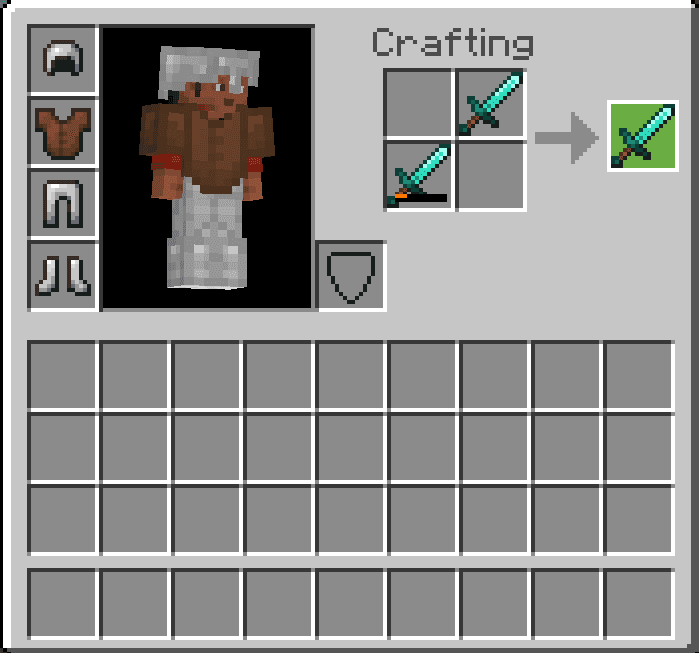
The simplest repair is combining two damaged tools of the same type in the crafting grid. Best used on unenchanted tools, because it wipes enchantments (only curses carry over). It works in both Java and Bedrock Edition. To do it:
- Place two damaged tools of the same type into the crafting grid.
- They merge into one, and the result's durability is the two combined totals plus a 5% bonus (5% of the tool's maximum).
- The repaired tool comes out unenchanted (curses are the only exception).
✅ Pros:
- No XP cost.
- Available from the very start of the game.
❌ Cons:
- Removes all enchantments (except curses).
- You need two of the same tool to do it.
2. Using an Anvil (Best for Enchanted Tools)
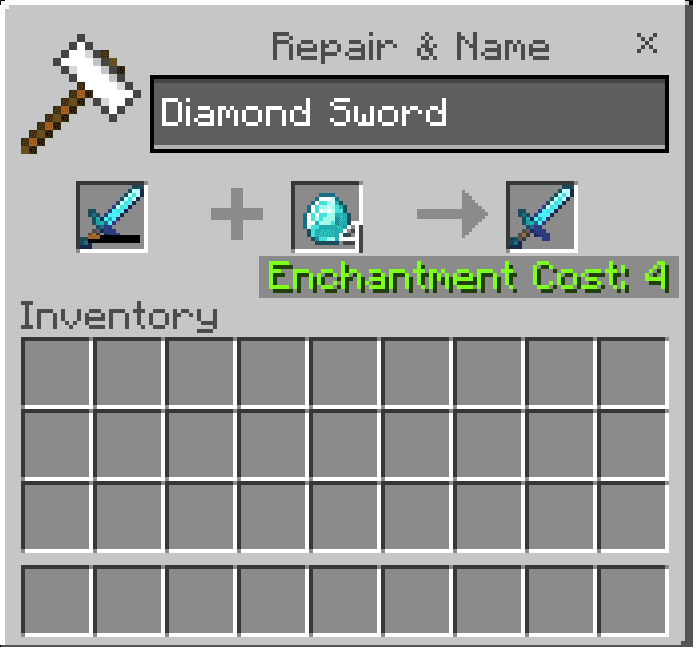
The anvil is the best repair method for enchanted tools—it's the only one that keeps enchantments. Here's how:
- Open an anvil (crafted from 3 blocks of iron and 4 iron ingots).
- Put your damaged tool in the first slot.
- Put an identical tool or its base material (e.g. Diamonds for a diamond pickaxe) in the second slot—material repair restores 25% per unit.
- The tool repairs while keeping its enchantments.
✅ Pros:
- Keeps enchantments—ideal for high-level gear.
- Can repair with raw materials, so you don't need a second tool.
❌ Cons:
- Costs XP levels each repair.
- Each repair adds a growing 'prior work penalty' until the anvil reads 'Too Expensive!'.
Use an anvil whenever you want to extend the life of your best gear without losing enchantments.
3. Using a Grindstone (Repair and Remove Enchantments)
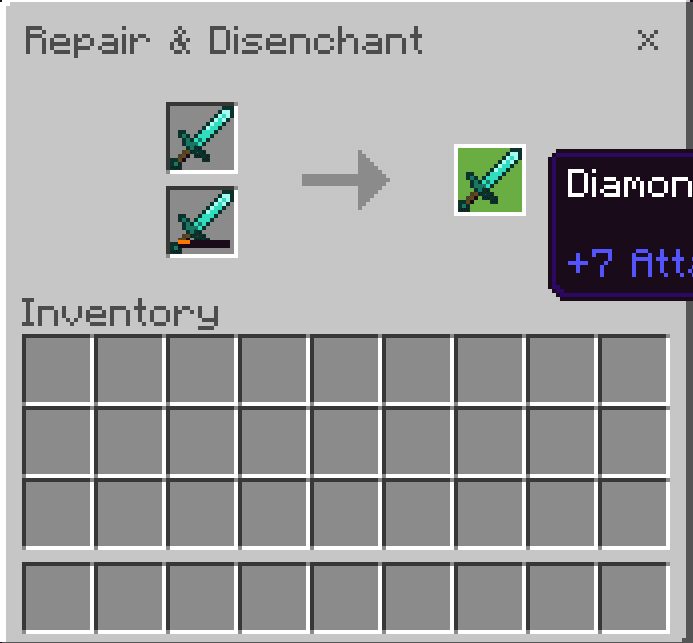
The grindstone works like grid repair—combine two of the same tool for the durability total plus 5%—but it has one extra job: it strips enchantments and refunds some of their XP.
- Place two damaged tools of the same type in the grindstone (a single item works too, just to disenchant).
- It restores durability and returns some XP for the enchantments it removes.
- It removes all enchantments except curses (like Curse of Vanishing).
✅ Pros:
- Refunds XP for stripped enchantments—handy for re-rolling gear.
- No XP cost to run.
❌ Cons:
- Erases enchantments, even valuable ones (curses stay).
- Can't preserve enchantments the way an anvil does.
Reach for a grindstone when you want to clear a tool's enchantments and reclaim some XP before re-enchanting it.
4. Using the Mending Enchantment (Infinite Repairs)

Mending is the best long-term repair method in Minecraft: it turns your XP into automatic, infinite repairs. It's a treasure enchantment (max level I), so you can't roll it at an enchanting table—you have to find it.
How Mending works
- XP you earn from mining, fishing, or fighting is spent repairing your held/worn gear before it reaches your bar.
- Mending works on any tool, weapon, or armor piece.
- It needs no anvil, grindstone, or grid—just XP. (Note: on bows it can't combine with Infinity.)
Where to find Mending
- Chest loot: trial chambers, desert pyramids, mineshafts, jungle pyramids, bastion remnants, strongholds, End cities, ancient cities, and vaults.
- Fishing can reel in a Mending-enchanted book.
- Trading with a Librarian villager of any level is the most reliable source. With the Villager Trade Rebalance experiment enabled, a master-level swamp Librarian sells it instead.
- Raid drops — *Bedrock Edition only*.
✅ Pros:
- Infinite repairs as long as you're earning XP.
- Keeps enchantments and durability—no anvil penalty.
- The best choice for high-tier enchanted gear.
❌ Cons:
- Must be found (loot, fishing, or a Librarian).
- Only repairs gear you're holding or wearing while gaining XP—items in a chest don't mend.
Found a Mending book? Apply it with an anvil as soon as you can.
Best Repair Method Comparison
| Method | Keeps Enchantments? | Costs XP? | Best Use Case |
|---|---|---|---|
| Grid repair | ❌ No | ❌ No | Early-game, unenchanted tools |
| Anvil | ✅ Yes | ✅ Yes | Repairing enchanted gear |
| Grindstone | ❌ No | ❌ No (refunds XP) | Stripping enchantments |
| Mending | ✅ Yes | ✅ Yes | Endgame, keep-forever gear |
Planning to stack Mending with Unbreaking on one tool? Our free Enchantment Planner works out the cheapest anvil order to combine your books and gear for the least XP—just pick your item and enchantments.
Open the Enchantment Planner →Smart Ways to Make Tools Last Longer
The cheapest repair is the one you never need. Before your gear wears down:
- Add Unbreaking — tools last about 2×, 3×, or 4× longer at levels I, II, and III (armor gains less).
- Add Mending so your gear repairs itself as you play.
- Carry a backup tool so a break never leaves you stranded.
- Use Netherite tools—they have the highest durability (2031) and don't burn in lava.
Final Thoughts: Keep Your Tools in Top Shape
Repairing tools saves resources and keeps your best gear in the game. Grid repair covers early tools; the anvil and Mending carry your enchanted gear. The endgame combo is Unbreaking + Mending—the closest thing to a truly unbreakable tool.
Frequently Asked Questions (FAQ)
Q: What's the cheapest way to repair tools in Minecraft?
A: Grid repair or a grindstone—both are free, but they remove enchantments (curses stay).
Q: Can you put Mending and Unbreaking on the same tool?
A: Yes, and it's the strongest combo: Unbreaking slows durability loss while Mending repairs what's left using XP.
Q: What happens if I repair a tool too many times with an anvil?
A: Each repair adds to a prior-work penalty. Once it's high enough the anvil shows 'Too Expensive!' and refuses—switch to Mending for gear you plan to keep.
Q: Does combining tools in the crafting grid work in Bedrock Edition?
A: Yes—grid repair works in both Java and Bedrock. It restores durability (plus a 5% bonus) and removes enchantments except curses.
Now go repair your gear and get back to building! 🚀