
Cave
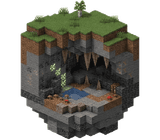
Cave is a generated structure in Minecraft.
Caves, sometimes referred to as caverns, are naturally occurring hollow spaces that form throughout the Overworld and the Nether. These underground voids are filled with air, water, or lava and frequently expose surrounding stone, deepslate, and ore deposits within their walls. Because light levels inside a Cave are typically very low, hostile mobs such as zombies, skeletons, and spiders tend to spawn freely inside them. Bats and glow squids are also common inhabitants.
There are two broad generation categories for a Cave: noise caves and carver caves. Noise caves are shaped by Perlin noise algorithms as part of the base terrain and appear in three forms — cheese caves, which are large open chambers; spaghetti caves, which form long winding passages; and noodle caves, which are narrower and more irregular. Noise caves may also contain speleothem-like pillars and underground liquid bodies known as aquifers, which hold water or lava depending on their depth.
Carver caves are generated as separate features layered on top of the base terrain. They can take the shape of winding tunnel networks with branching passages or ellipsoidal chambers. A carver Cave can break through to the surface, intersect with mineshafts or monster rooms, and appears in the Overworld between Y=−56 and Y=180, as well as in the Nether between Y=0 and Y=126.
Several distinct Cave biomes exist in the Overworld. Dripstone caves feature pointed dripstone formations and block pillars. Lush caves contain cave vines, azalea plants, clay pools, and serve as spawning grounds for axolotls. The deep dark is a particularly hazardous deepslate biome housing sculk blocks and ancient cities watched over by wardens.