
Villager
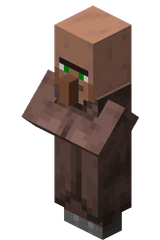
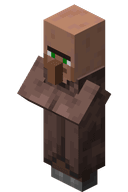
Villager is a passive mob in Minecraft. Villager has 20 health points (10 hearts).
Villager is the mob the survival economy runs on: every emerald trade, every enchanted book you did not have to roll, and every iron golem farm traces back to one. A villager takes its job from the job site block it claims and its clothes from the biome it was born in, so a swamp cartographer and a savanna cartographer wear different coats and sell different village maps.
Villager breeding is not something you can force with hearts. Two adults become willing once they are carrying enough food — bread, carrots, potatoes, or beetroot — and a villager breeder works by throwing crops at them and giving them beds with two empty blocks of headroom above. Claimed beds cap the population, so a stalled breeder is almost always short of beds rather than short of food.
The job site block is also the reset switch. An unemployed adult claims any unclaimed workstation nearby and takes that profession; breaking and replacing the block re-rolls its trades, but only until it completes a first trade, after which the profession is locked for good. Separated from its workstation a villager stops restocking, which is why a trading hall keeps the block within reach. Villager houses generate with the matching block already inside — a grindstone in the weaponsmith house, a stonecutter in the mason house.
A zombie kill can convert a villager rather than ending it — guaranteed on Hard, a coin flip on Normal — and that conversion is worth engineering. Curing a zombie villager with a splash potion of Weakness and a golden apple permanently lowers its prices, and it stays cheap for good. In Java Edition, a villager that has watched you hurt one of its own remembers it too, and raises prices accordingly.
 )( × 10)