Best Y Level for Netherite in Minecraft
By
Minecraft Search
|
10 min read
|
Updated on
September 15, 2026
Written with AI assistance.
TL;DR: What Is the Best Y Level for Netherite?
- ✅ The best Y level for netherite is Y 15 in Java Edition. Stand at Y 15 and your 2-block-tall tunnel covers Y 15 and Y 16 — the two densest layers in the game's distribution.
- ✅ Java's dense band is shaped; Bedrock's is flat. Java rolls the deep vein on a trapezoid over Y 8–24, so density peaks in the middle. Bedrock rolls its deep clusters evenly over Y 8–23 — every level in that band is equally good, so pick the depth with the least lava.
- ✅ A third of the game's debris rolls happen above Y 24. A second, thinner generation pass spreads debris evenly from Y 8 all the way to Y 119 — which is why people genuinely do find it at Y 90.
- ✅ Ancient debris never generates touching air in Java. You will never see it in a cave wall or a lava lake — it is always buried, which is why tunneling works and sightseeing does not.
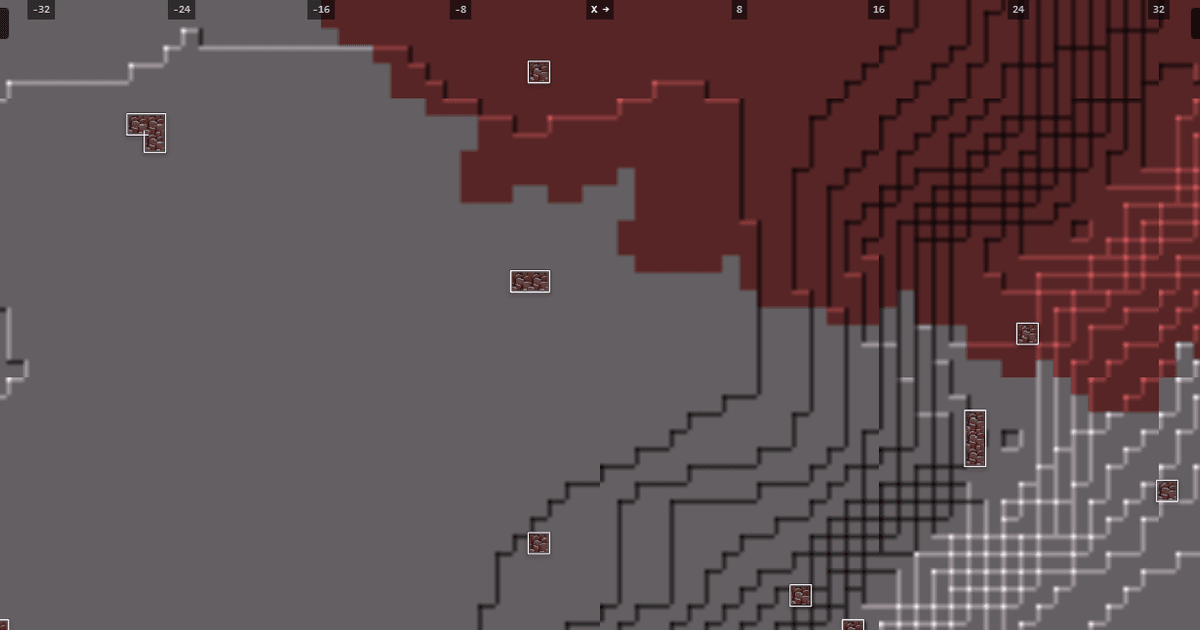
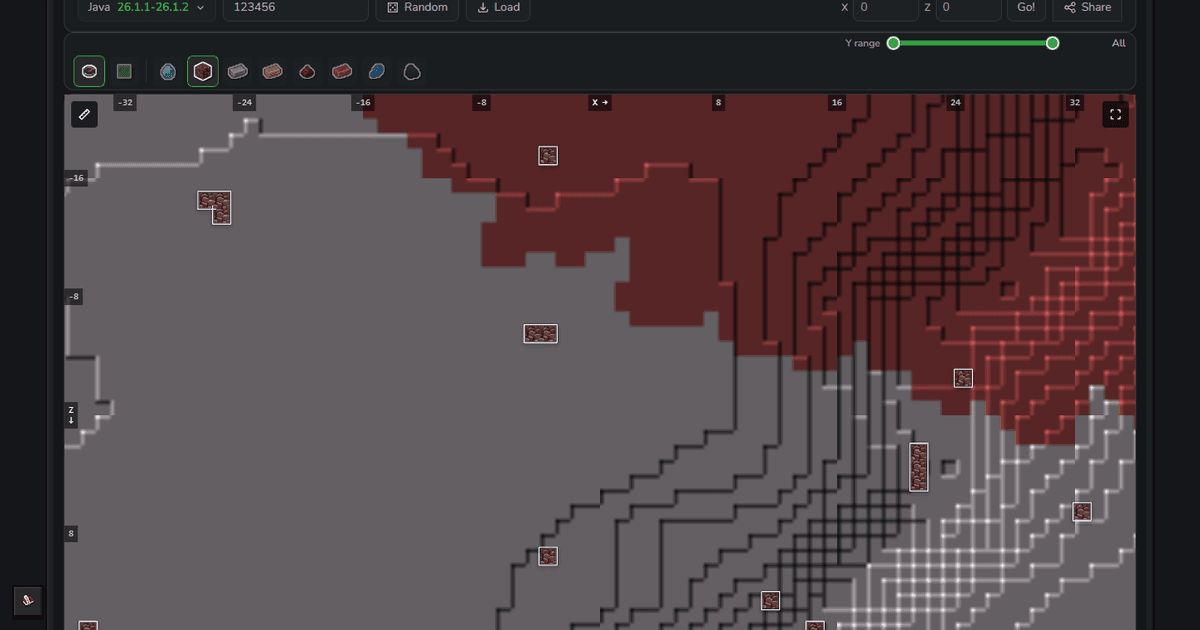
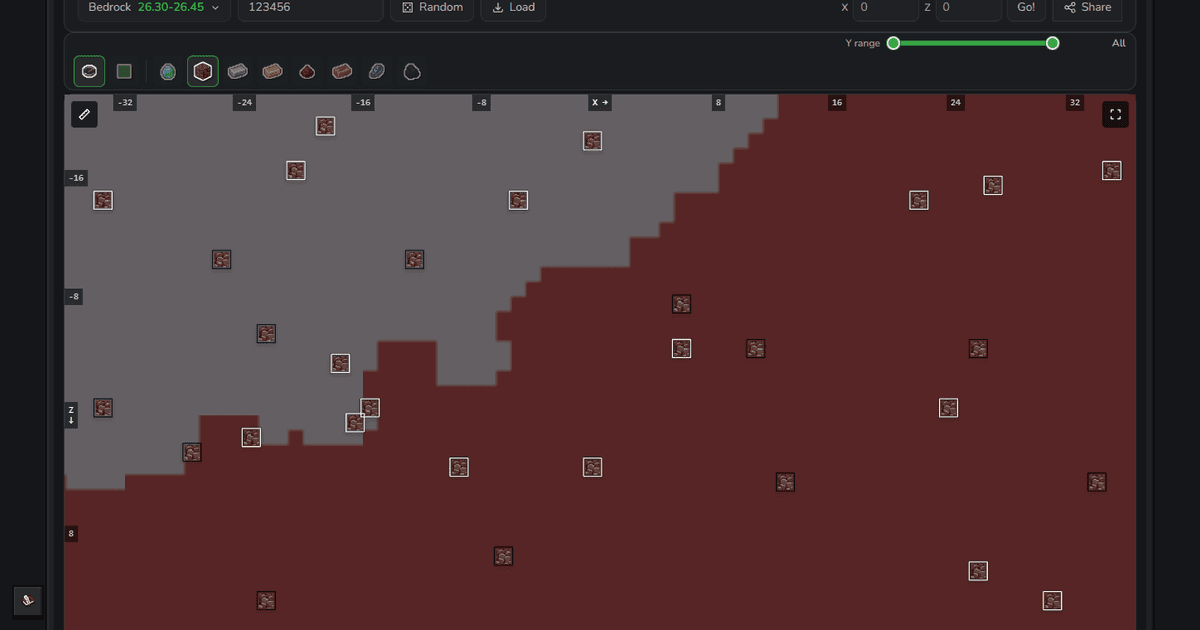
- ✅ Skip the tunnel entirely: our Ancient Debris Finder reads your seed and marks the ancient debris in your own world, Java and Bedrock.
Every netherite guide gives you the same sentence: mine at Y 15, dig a long tunnel, blow it up with beds. That is not wrong — Y 15 really is the best Y level for netherite — but it is about a fifth of the answer, and the missing four fifths is what decides whether you come home with three ancient debris or thirty. The Nether does not scatter debris evenly, it does not scatter it the same way on both editions, and it does not keep it all in the band everyone tunnels through. Here is the whole distribution, the mining methods ranked by what they actually cost, and the bastion chests that can hand you a netherite ingot without a pickaxe.
What Y Level Is Ancient Debris in Minecraft?
Ancient debris is densest at Y 15–16 and generates anywhere from Y 8 to Y 119, with the dense band running Y 8 to 24 (as of Java 26.2 and Bedrock 1.26.45). The reason a single number gets quoted at all is that the game rolls debris in two completely separate passes, and only one of them cares where you are standing.
The first pass is the dense one: a deep vein rolled on a trapezoid distribution between Y 8 and Y 24. A trapezoid means the middle of the range is far more likely than its edges — the layer at Y 16 is picked roughly nine times as often as the layer at Y 8. That shape is the entire reason "mine at Y 15" exists, and it is the thing every guide states as a number without ever showing you the curve.
| Y level | Share of deep vein rolls | Density vs Y 16 | What that means for you |
|---|---|---|---|
| Y 8 | 1.23% | 16% | Bottom edge of the band — barely worth the walk down |
| Y 11 | 4.94% | 47% | A popular "deep is better" myth level. It is half as good |
| Y 12 | 6.17% | 58% | Still well below the peak |
| Y 14 | 8.64% | 79% | Fine — your head is at Y 15 |
| Y 15 | 9.88% | 89% | Stand here. Feet at 15, head at 16 |
| Y 16 | 11.11% | 100% — the peak | The single densest layer in the game |
| Y 17 | 9.88% | 89% | Mirror of Y 15 |
| Y 20 | 6.17% | 58% | Same as Y 12, on the other side |
| Y 24 | 1.23% | 16% | Top edge of the band |
| Y 25 to Y 119 | 0% | 5% | The deep vein never rolls here — but the second pass does |
Read the last row again, because it is the one nobody prints. Above Y 24 the dense pass stops completely, and everything you find up there comes from a second, thinner generation pass spread evenly from Y 8 to Y 119. It is quiet, but it is not small: 33.9% of the game's debris rolls land above Y 24, and only 66.1% land inside the band you are tunneling through. Between them the two passes average 2.5 debris blocks per chunk — before the game throws away every one that would have ended up touching air, which is far more common in the open, cave-riddled upper Nether than it is down at Y 15. That culling is the real reason the deep band still wins: not just more rolls, but more rolls that survive.
Why Is Y 15 the Answer if Y 16 Is the Peak?
Because you are two blocks tall. A player standing at Y 15 breaks blocks at both feet level and head level, so a plain 2-block-tall tunnel dug at Y 15 sweeps Y 15 and Y 16 together — the peak layer and the best layer next to it, in one pass, at no extra cost. Standing at Y 16 would cover Y 16 and Y 17, which is very slightly worse. That is the whole trick, and it is why Y 15 has been the community answer for years even though the raw distribution peaks one block higher.
It also tells you which mistakes are expensive and which are not. Dropping to Y 11 on the instinct that deeper must be better costs you about half your debris per block mined. Being one block off at Y 14 or Y 17 costs you almost nothing. The band is the answer; the single level is just where you happen to stand inside it.
Why you never see ancient debris in a cave
In Java Edition, ancient debris is discarded if it would generate touching air. It cannot appear in a cave wall, a ravine, or the roof of a lava lake — it is always fully buried in netherrack, basalt or blackstone. Walking around looking for it is not unlucky, it is impossible. This is also why ancient debris never burns or floats away in lava: it is blast resistant and it does not move.
Is the Best Y Level for Netherite Different on Bedrock?
Yes — and this is the single most repeated piece of bad advice about netherite. Bedrock's deep band has no peak. Where Java shapes its deep vein on a trapezoid that concentrates around Y 16, Bedrock rolls its deep clusters uniformly over Y 8 to Y 23: every layer in that band is exactly as likely as every other one. "Mine at Y 15" is a Java answer being repeated to Bedrock players, who gain nothing from it.
That is not bad news for Bedrock — it is freedom. If Y 15 is a lava-riddled mess in your area, drop to Y 10 or climb to Y 21 and lose nothing at all. Pick the quietest depth you can find and tunnel there.
| Java 26.2 | Bedrock 1.26.45 | |
|---|---|---|
| Dense generation band | Y 8–24, trapezoid-shaped | Y 8–23, flat |
| Densest single layer | Y 16 | None — all levels in the band are equal |
| Level to stand at | Y 15 (tunnel covers Y 15–16) | Any level Y 8–23 — pick the one with the least lava |
| Second, thinner pass | Y 8–119, even spread | Y 8–119, even spread |
| Can you spot it in a cave wall? | No — the game discards any that would be exposed | No — you find it by digging, never by looking |
| Pickaxe needed |  Diamond Pickaxe or Diamond Pickaxe or  Netherite Pickaxe Netherite Pickaxe | Diamond Pickaxe or Netherite Pickaxe |
Does the Nether Biome Change Where Ancient Debris Spawns?
No. Ancient debris generates in every Nether biome at the same rate — it replaces the Nether's base stone, and every biome is built on the same base stone. What the biome changes is how pleasant the digging is, and that is worth choosing for.
| Biome | Debris rate | What it is actually like to tunnel through |
|---|---|---|
 Nether Wastes Nether Wastes | Same as everywhere | Plain  Netherrack, few surprises — the easiest place to run a long tunnel Netherrack, few surprises — the easiest place to run a long tunnel |
 Crimson Forest Crimson Forest | Same as everywhere | Solid ground, good visibility,  Piglin patrols to watch for Piglin patrols to watch for |
 Soul Sand Valley Soul Sand Valley | Same as everywhere | Wide open and fast to cross, but ghasts have a clear line of sight |
 Basalt Deltas Basalt Deltas | Same as everywhere | Worst choice:  Basalt and blackstone are slow to break and lava is everywhere Basalt and blackstone are slow to break and lava is everywhere |
A band is a probability. Your seed is a fact. Our Ancient Debris Finder reads your world seed and marks the ancient debris on a map of your own Nether — so instead of digging a kilometre of tunnel and hoping, you fly to a set of coordinates and dig straight down to it. Java and Bedrock, no mods and no cheats.
Find the ancient debris in your seed →How Do You Actually Mine the Band?
Dig a straight 2-block-tall tunnel at Y 15 and branch off it, or blast the band open with beds or TNT. Which one is right depends entirely on what you have spare, not on which is "fastest" in the abstract — every method finds the same debris, they just pay for it differently.
| Method | What you need | Best when | Watch out for |
|---|---|---|---|
| Straight tunnel at Y 15 | Diamond Pickaxe and time | You have Efficiency and Haste, or you are early on resources | Slow, but it is the only method that costs you nothing but durability |
| Bed mining |  Bed (many) and a blast-resistant hiding spot Bed (many) and a blast-resistant hiding spot | You can farm wool cheaply and want big holes fast | Beds explode when used in the Nether. Place, step back, detonate from behind cover — never stand next to one |
| TNT mining |  TNT — gunpowder and sand TNT — gunpowder and sand | You have a creeper or ghast farm running | Needs a real supply chain; a handful of TNT is not a strategy |
| Chest looting |  Bastion Remnant and something that survives piglins Bastion Remnant and something that survives piglins | You want netherite without mining at all | Bridge bastions carry none of it — see the odds below |
Whatever you use, mine the debris itself with a diamond or netherite pickaxe — anything weaker destroys the block and drops nothing. Ancient debris has ten times the hardness of diamond ore, so Efficiency and a Haste beacon change your yield per hour far more than arguing about Y 11 versus Y 15 ever will.
Can You Get Netherite Without Mining?
Yes — bastion remnant chests carry ancient debris, netherite scrap and even finished netherite ingots, and one bastion type carries a lot of it. These are the real Java 26.2 loot-table odds, and they are lopsided enough to change where you spend your afternoon.
| Bastion type | Chance of debris, scrap or a netherite ingot | Smithing template chance |
|---|---|---|
| Treasure room | 70.0% per chest (three rolls at 33.0% each) — and a 35.0% shot at a finished  Netherite Ingot Netherite Ingot | Guaranteed — one  Netherite Upgrade in every treasure room chest Netherite Upgrade in every treasure room chest |
| Hoglin stable | 25.0% per chest | 10% — Netherite Upgrade |
| Housing units / other | 18.0% per chest | 10% — Netherite Upgrade |
| Bridge | None — zero debris, scrap or ingots | 10% — Netherite Upgrade |
So one treasure room chest is worth about four hoglin stable chests for netherite, and a bridge bastion is worth none at all. The template matters just as much as the metal: every single upgrade consumes one, so four armor pieces need four templates. A treasure room hands you one for free, and you can duplicate it on a crafting table with 7 diamonds and 1 netherrack — which returns two templates for one, so it pays for itself immediately. Our Bastion Finder will tell you where the bastions in your seed are before you fly out to them.
How Much Ancient Debris Do You Need for a Full Set?
Sixteen ancient debris for a full set of netherite armor, thirty-six if you want the tools too. Every netherite item costs one ingot, every ingot costs four scrap plus four gold, and every scrap is one ancient debris smelted in a blast furnace or a regular furnace.
| You need | One item | Full armor (4 pieces) | Armor + sword, pickaxe, axe, shovel, hoe (9) |
|---|---|---|---|
 Ancient Debris Ancient Debris | 4 | 16 | 36 |
 Netherite Scrap Netherite Scrap | 4 | 16 | 36 |
 Gold Ingot Gold Ingot | 4 | 16 | 36 |
| Netherite Ingot | 1 | 4 | 9 |
| Netherite Upgrade | 1 | 4 | 9 |
 Smithing Table Smithing Table | 1 | 1 | 1 |
The ingot recipe is shapeless, so the four netherite scrap and four gold ingots can go anywhere in the grid — you can see the real grid on our netherite ingot page. The smithing table is a one-off: you need exactly one, no matter how much gear you upgrade.
Sixteen debris is a lot less than it sounds once you stop tunneling blind. Two treasure-room bastions and a short session at Y 15 will usually get you there — and if you want to know exactly how far that session has to go, the Ancient Debris Finder will show you the debris in your own seed before you break a single block. If you are working the overworld half of the same problem, our guide to finding diamonds does the same job for Y −59.
Frequently Asked Questions (FAQ)
Q: What is the best Y level for netherite in Minecraft?
A: Y 15 in Java Edition — standing there puts your 2-block-tall tunnel across Y 15 and Y 16, which are the two densest layers. On Bedrock the dense band is flat from Y 8 to Y 23, so any level inside it works equally well.
Q: Is Y 11 or Y 15 better for ancient debris?
A: Y 15, clearly. Y 11 sits near the bottom edge of the trapezoid and carries only about 47% of the density of the Y 16 peak, so you mine roughly twice as many blocks for the same debris.
Q: Can ancient debris generate above Y 24?
A: Yes. A second generation pass spreads debris evenly from Y 8 to Y 119, and it accounts for 33.9% of the game's debris rolls. Fewer of those survive — the game discards any debris that would generate touching air, and the upper Nether is far more open — but it is much thinner per layer regardless, which is why tunneling at Y 15 is still the right call. Finding debris at Y 90 is not a fluke.
Q: How rare is ancient debris?
A: Rare enough that position matters more than luck. The game averages 2.5 ancient debris rolls per chunk across the whole height of the Nether, two thirds of them in the Y 8–24 band, and it then discards any that would have generated touching air. It is the one ore you cannot spot in a cave wall — you have to dig through it.
Q: What pickaxe do you need to mine ancient debris?
A: A diamond or netherite pickaxe. A gold, iron or stone pickaxe will break the block and drop nothing at all.
Q: Can ancient debris burn or be destroyed by lava?
A: No. Ancient debris is blast resistant and cannot be destroyed by TNT or lava, so it stays exactly where it generated — which is why bed and TNT mining never destroys the thing you are looking for. As a dropped item it is fireproof and floats on lava, so you will not lose it on the way home either.
Q: How many ancient debris do you need for full netherite armor?
A: Sixteen, plus 16 gold ingots and four Netherite Upgrade Smithing Templates. Each armor piece takes one netherite ingot, and each ingot takes four netherite scrap smelted from four ancient debris.