Minecraft Villager Trades: Best Trades & Full Chart (Java + Bedrock)
By
Gunter
|
9 min read
|
Updated on
July 20, 2026
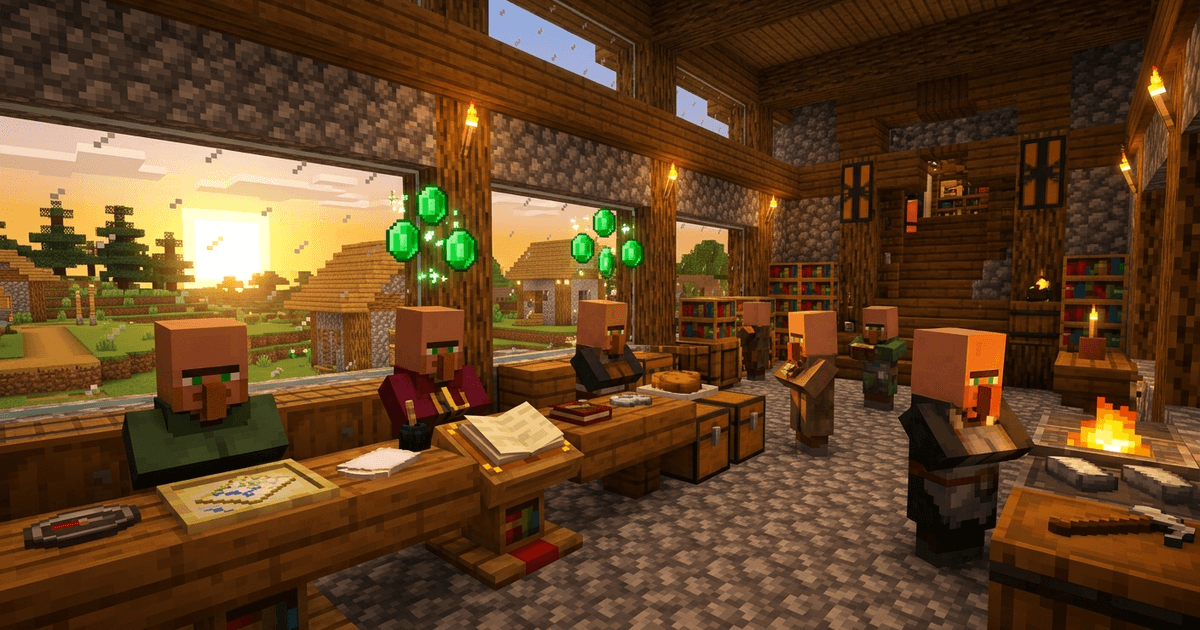
TL;DR: Minecraft Villager Trades
- 📖 The single best trade is a Librarian's Mending book — the most reliable renewable source of Mending, which repairs gear with XP forever.
- 💎 Cheapest emeralds: sell a Fletcher 32 sticks or a Farmer 20 wheat for 1 emerald — both are trivially renewable.
- ⚔️ Best gear deals: Armorer, Toolsmith and Weaponsmith sell enchanted diamond gear for ~13–35 emeralds a piece — far cheaper than mining and gambling on the enchanting table.
- 🧱 There are 13 professions + the Wandering Trader, each with 5 trade tiers (Novice → Master). Trades are ~96% identical in Java and Bedrock.
- 🗺️ No village nearby? Our free Village Finder locates one for your exact seed, Java or Bedrock.
Villager trading is the best economy in Minecraft: it turns renewable junk like sticks and rotten flesh into emeralds, and emeralds into enchanted diamond gear, Mending books, ender pearls and explorer maps. The catch is that the trade lists are enormous and most of them aren't worth your time. This guide cuts through it: how trading works, the handful of minecraft villager trades actually worth building a hall around, the cheapest ways to farm emeralds, and a full chart by profession — current to Java 26.2 / Bedrock 1.26.40, both editions.
How do villager trades work in Minecraft?
An unemployed villager claims a job-site block (a Lectern makes a Librarian, a Composter makes a Farmer) and offers trades priced in emeralds. Every trade you make gives the villager trade XP, which unlocks higher tiers — there are five: Novice, Apprentice, Journeyman, Expert, and Master. The best trades (Mending books, enchanted diamond gear, ender pearls) live in the upper tiers, so you have to trade your way up. A working villager also restocks up to twice per day, so the good trades keep coming back.
| Trade tier | Trade XP needed | What it means |
|---|---|---|
| Novice | 0 | Starting tier — the villager's cheapest buy/sell trades |
| Apprentice | 10 | Unlocks after a handful of trades |
| Journeyman | 70 | Mid-tier: explorer maps, glowstone, crossbows |
| Expert | 150 | Ender pearls, enchanted diamond boots/leggings |
| Master | 250 | Top gear: enchanted diamond helmet, chestplate, pickaxe, sword |
Pro tip:
Trade XP is per villager, not per profession — so it's worth funnelling all your trading through the few villagers whose master-tier trades you actually want, instead of spreading it thin.
What are the best villager trades?
The best villager trades are the ones that give you something you can't easily get any other way: renewable Mending, cheap enchanted diamond gear, renewable ender pearls, and explorer maps that pinpoint rare structures. Everything else is a nice-to-have. Here's what to prioritise, and why.
| Trade | Villager (tier) | Typical cost | Why it's worth it |
|---|---|---|---|
| Mending enchanted book | Librarian (any tier) | ~10–38 emeralds | The most reliable renewable source of Mending — keeps tools, armor and weapons alive forever |
| Enchanted diamond armor | Armorer (Expert–Master) | ~13–35 emeralds/piece | A full enchanted diamond set for a stack of emeralds, no diamonds mined |
| Enchanted diamond pickaxe / sword / axe | Toolsmith / Weaponsmith (Master) | ~13–31 emeralds | Cheaper and more reliable than mining diamonds and gambling on the enchant table |
| Ender pearl | Cleric (Expert) | 5 emeralds each | Renewable pearls without hunting Endermen — great for a nether hub or End prep |
| Ocean / Woodland explorer map | Cartographer (Journeyman / Master) | ~13–14 emeralds + a compass | The only reliable way to locate an Ocean Monument or Woodland Mansion |
| Glowstone | Cleric (Journeyman) | 4 emeralds | Renewable glowstone with no Nether trip |
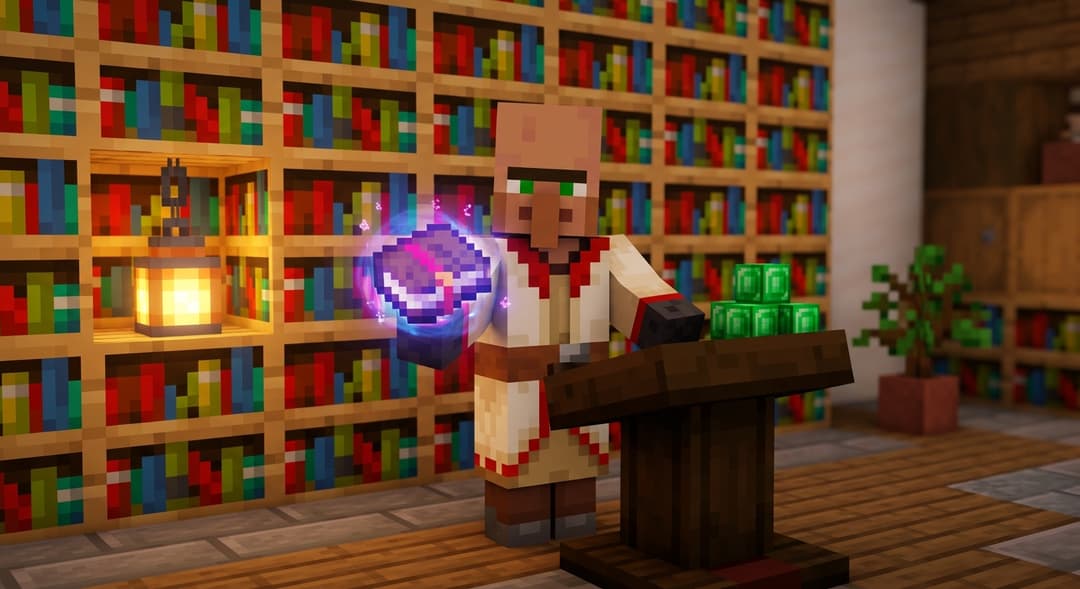
The standout is the Librarian. Enchanted books are on offer at *every* tier, so you don't even need to level one up to buy Mending — you just need a Librarian who happens to offer it. If yours doesn't, you can reroll it (see rerolling trades below). For more on why Mending tops every list, see our guide to the best enchantments in Minecraft.
What is the best villager trade for emeralds?
The cheapest way to farm emeralds is to sell a renewable item you can automate. A Fletcher buys 32 sticks for 1 emerald — and sticks come from bamboo or any tree farm, so this is effectively free money. A Farmer buying crops is a close second and even easier to set up. Rotten flesh, paper and coal round out the reliable buy trades.
| Sell this | To (Novice tier) | Rate | Renewable via |
|---|---|---|---|
 Stick Stick | Fletcher | 32 → 1 emerald | Bamboo or tree farm (near-free) |
 Wheat Wheat | Farmer | 20 → 1 emerald | Auto wheat farm |
 Carrot / Carrot /  Potato Potato | Farmer | 22 / 26 → 1 emerald | Villager-run crop farm |
 Rotten Flesh Rotten Flesh | Cleric | 32 → 1 emerald | Zombie / mob farm |
 Paper Paper | Librarian / Cartographer | 24 → 1 emerald | Sugar cane farm |
 Coal Coal | Armorer / Toolsmith / Weaponsmith | 15 → 1 emerald | Mining or a coal supply |
One villager caps at 16 uses per restock on most buy trades, so the fastest emerald farms run several Farmers or Fletchers side by side and top them up twice a day.
Full villager trades chart by profession
There are 13 job professions, each tied to one job-site block. Here's what every profession buys for emeralds and the highlights of what it sells, so you know which villager to build for. (The Wandering Trader has no job block and roams the world with a rotating, temporary stock.)
| Profession | Job block | Buys for emeralds | Sells (highlights) |
|---|---|---|---|
| Farmer |  Composter Composter | Wheat, carrots, potatoes, beetroot, pumpkin, melon | Bread, golden carrots, cake, pumpkin pie, cookies |
| Fisherman |  Barrel Barrel | String, coal, cod, salmon | Cooked fish, enchanted fishing rod, campfire, boats |
| Shepherd |  Loom Loom | Wool, all 16 dyes | Beds, wool, carpet, banners, paintings, shears |
| Butcher |  Smoker Smoker | Chicken, porkchop, rabbit, mutton, beef, coal, dried kelp block | Cooked meat, rabbit stew |
| Fletcher |  Fletching Table Fletching Table | Sticks, flint, string, feathers, tripwire hooks | Arrows, bows, crossbows, tipped arrows |
| Librarian |  Lectern Lectern | Paper, books, ink sacs | Enchanted books, bookshelves, lanterns, glass, clock, compass |
| Cartographer |  Cartography Table Cartography Table | Paper, glass panes, compass | Explorer maps, banners, item frames, globe banner pattern |
| Cleric |  Brewing Stand Brewing Stand | Rotten flesh, gold ingots, rabbit's foot, glass bottles, nether wart | Redstone, lapis lazuli, glowstone, ender pearls, bottle o' enchanting |
| Armorer |  Blast Furnace Blast Furnace | Coal, iron ingots, diamonds | Iron / chainmail / enchanted diamond armor, shields, bells |
| Toolsmith |  Smithing Table Smithing Table | Coal, iron ingots, flint, diamonds | Stone & enchanted iron / diamond tools, bells |
| Weaponsmith |  Grindstone Grindstone | Coal, iron ingots, flint, diamonds | Enchanted iron / diamond swords & axes, bells |
| Mason |  Stonecutter Stonecutter | Clay, stone, granite, andesite, diorite, quartz | Bricks, polished stone, terracotta, glazed terracotta, dripstone |
| Leatherworker |  Cauldron Cauldron | Leather, flint, rabbit hide | Leather armor, saddle, leather horse armor |
Want the exact prices, stock and tier for a specific trade? Every villager and item has its full, both-editions trade table on its catalog page — for example the Librarian page lists every enchanted-book tier, and the emerald page shows everything you can sell for one.
Are villager trades different in Java and Bedrock?
Almost entirely — but not quite, and what differs is not only mechanical. Compared trade-for-trade against the shipped game files, the item, price, stock and tier match on about 96% of trades: the same 13 professions, the same 5 tiers and the same job-site blocks. Most of the remainder is mechanical — how many trades unlock per tier, what a villager needs to restock, and how discounts stack. But a few differences are in the trades themselves: a Farmer’s Expert cake costs 3 emeralds on Java and 1 on Bedrock, and a Weaponsmith’s Novice enchanted iron sword can be bought 12 times on Java but only 3 times on Bedrock.
| Detail | Java 26.2 | Bedrock 1.26.40 |
|---|---|---|
| Trade items, prices & tiers | — baseline — | ~96% identical — with a few real price and stock differences |
| Trades that really differ | Cake 3 emeralds; enchanted iron sword 12 uses | Cake 1 emerald; enchanted iron sword 3 uses |
| Biome-locked offers | 27 offers depend on the villager’s biome variant — only a snow or plains Cartographer sells a white banner | None — any villager of a profession can offer anything in its pool |
| New trades unlocked per tier | Exactly 2 per level (up to 10 total) | 1–3 per level (about 7–10 total) |
| Restocking | Needs access to its job-site block | Also needs a bed nearby |
| Zombie-cure discounts | Stack down toward 1 emerald with repeated cures (gossip system) | Apply, but don't stack as deeply |
| Hero of the Village discount | Yes | Yes |
How do you reroll or reset a villager's trades?
If a villager's offer isn't what you want — the classic case is a Librarian without Mending — you can reroll it as long as you haven't traded with it yet. Break its job-site block, wait for the villager to lose its profession (its clothing reverts), then place the block again. It picks a new profession's worth of trades, including a fresh random enchanted book. Once you make even one trade, the offers lock in and can't be rerolled.
- Put down a Lectern next to an unemployed villager and wait for it to become a Librarian.
- Check the enchanted-book trade without trading. If it isn't the enchantment you want (Mending, Unbreaking III, Efficiency V…), break the Lectern.
- Place the Lectern again to reroll. Repeat until the book you want appears, then trade to lock it.
- For discounts, cure a zombie villager with a Splash Potion of Weakness + a golden apple — a cured villager gives permanently cheaper prices.
Trading starts with finding a village. Our free Village Finder pinpoints the nearest village for your exact seed — Java or Bedrock — so you can head straight there and start setting up a trading hall.
Open the Village Finder →Frequently Asked Questions (FAQ)
Q: What is the best villager to trade with?
A: The Librarian, for its enchanted books — specifically a Mending book, the most reliable renewable source of the game's most valuable enchantment. After that, the Armorer, Toolsmith and Weaponsmith for cheap enchanted diamond gear, and the Cleric for renewable ender pearls.
Q: What is the best villager trade for emeralds?
A: Selling sticks to a Fletcher (32 sticks for 1 emerald) or crops to a Farmer (20 wheat / 22 carrots / 26 potatoes for 1 emerald). All of these inputs are trivially renewable, so they're effectively free emeralds once the farm is running.
Q: How do you reset villager trades?
A: Break and replace the villager's job-site block (for example a Librarian's Lectern) before you trade with it. This rerolls all of its trades. Once you make a single trade, the offers lock permanently and can no longer be rerolled.
Q: Do villager trades restock?
A: Yes. A villager restocks its trades up to twice per day, but only if it can path to and use its job-site block. That's why trading halls keep each villager next to its workstation.
Q: What is the maximum villager trade level?
A: Master, the fifth tier, reached at 250 trade XP. The tiers in order are Novice, Apprentice, Journeyman, Expert and Master, and a villager's badge changes colour (from stone to emerald) as it levels up.
Q: Are villager trades the same in Java and Bedrock?
A: The trades are about 96% identical — the same professions, tiers and job blocks, and on almost every row the same items and prices. A few really do differ: a Farmer’s Expert cake is 3 emeralds on Java and 1 on Bedrock, and a Weaponsmith’s Novice enchanted iron sword has 12 uses on Java against 3 on Bedrock. The rest is mechanical: Java unlocks exactly 2 trades per tier while Bedrock unlocks 1–3, Java gates 27 offers behind the villager’s biome variant while Bedrock gates none, Bedrock villagers also need a bed nearby to restock, and Java’s gossip system lets zombie-cure discounts stack lower.