How to Get a Happy Ghast in Minecraft
By
Gunter
|
11 min read
|
Updated on
September 7, 2026

TL;DR: How Do You Get a Happy Ghast?
- ✅ You cannot craft, tame or breed a happy ghast. You place a Dried Ghast block in water, wait about 20 minutes for it to hydrate into a Ghastling, then wait another 20 minutes (or feed it snowballs) for it to grow into an adult Happy Ghast.
- ✅ The Dried Ghast is the hard part. It generates beside Nether fossils in soul sand valleys — and only about one fossil in three carries one.
- ✅ Two backup routes: craft it from 8 Ghast Tears around 1 Soul Sand, or barter with a piglin (~2.13% per gold ingot).
- ✅ To fly it you need a Harness — 3 leather, 2 glass and 1 wool. It seats four players at once.
- ✅ Skip the searching: our Nether Fossil Finder marks which fossils in your seed actually have a Dried Ghast next to them.
Almost every guide on how to get a happy ghast tells you the same four words — hydrate a Dried Ghast — and then stops. That is the easy half. The half that actually costs you an evening is finding the Dried Ghast in the first place, because it hides in soul sand valleys, next to a structure that only sometimes has one, in a dimension where standing still gets you shot at. This guide answers the head question in one paragraph and then spends the rest of its time on the part nobody else solves: getting your hands on a Dried Ghast without wandering the Nether for an hour. Everything below is current as of Java 26.2 and Bedrock 1.26.40.
How Do You Get a Happy Ghast in Minecraft?
You get a happy ghast by placing a Dried Ghast block in water until it rehydrates into a Ghastling, then letting that ghastling grow up. There is no taming, no breeding, no spawn condition you can farm — the mob only enters the world through that one block. The whole chain takes about 40 minutes of real time if you leave it alone, and a lot less if you throw snowballs at it.
| Stage | What you need | How long | What you get |
|---|---|---|---|
| 1. Get the block |  Dried Ghast — found, crafted or bartered Dried Ghast — found, crafted or bartered | The slow part — see below | A Dried Ghast in your inventory |
| 2. Hydrate it | Place it in water (any source block) | ~20 minutes, four hydration stages | It cracks open into a  Ghastling Ghastling |
| 3. Grow it up | Nothing, or  Snowball to speed it up Snowball to speed it up | 20 minutes (24,000 ticks) on its own | An adult  Happy Ghast Happy Ghast |
| 4. Fly it | A harness — e.g.  White Harness White Harness | One crafting table | A four-seat flying mount |
The one thing people get wrong
A happy ghast is not a tamed ghast. They are separate mobs — the hostile ghast that fires fireballs at you across the Nether Wastes has nothing to do with this, and killing one will never give you a Dried Ghast. It does drop ghast tears, though, which is how the crafting route works.

Where Do You Find a Dried Ghast?
Dried Ghasts generate in soul sand valley biomes, sitting next to Nether fossil structures — and only one fossil in three has one. That single fraction is why this step eats so much time: a Nether fossil is a pile of 5 to 27 bone blocks, they are scattered thinly through a biome that is already rare, and two out of every three you walk to will have nothing beside them. You are not doing one search, you are doing three.
There are exactly three ways to obtain the block, and they are wildly different in cost:
| Route | Where | Rate | Realistically |
|---|---|---|---|
| Find it | Beside a  Nether Fossil in a Nether Fossil in a  Soul Sand Valley Soul Sand Valley | ~1 in 3 fossils | Free, but you must locate the fossils first |
| Craft it | Crafting table, from  Ghast Tear + Ghast Tear +  Soul Sand Soul Sand | Guaranteed | Needs 8 tears — that is roughly 16 ghast kills |
| Barter | Give  Gold Ingot to a Gold Ingot to a  Piglin Piglin | ~2.13% per ingot | About 47 ingots per Dried Ghast on average |
Finding one is by far the cheapest — if you know which fossils to walk to. That is the entire problem, and it is a coordinate problem, not a crafting problem.
Our Nether Fossil Finder reads your seed and marks every Nether fossil in your world — and gives the ones that actually carry a Dried Ghast their own marker, so you fly to a fossil that has one instead of checking three that don't. Java and Bedrock, no mods, no cheats.
Find the Dried Ghasts in your seed →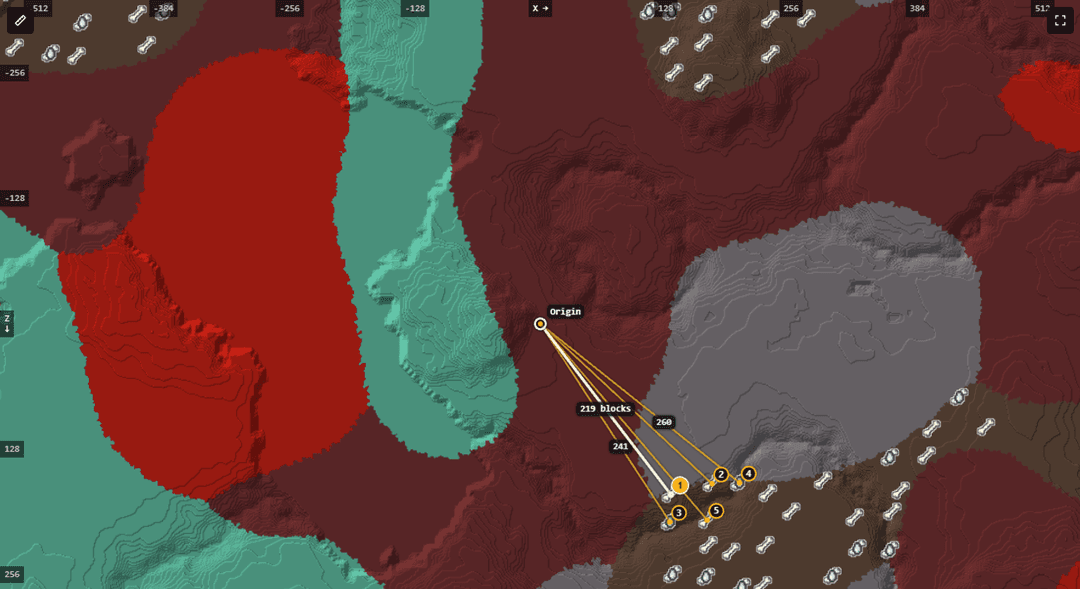
Two honest caveats, because they matter more than a marketing line. The finder marks Dried Ghasts on Java 1.21.6 and newer and on Bedrock 1.21.120 and newer. On Bedrock 1.21.90 through 1.21.114 the fossils themselves still appear, but we cannot yet work out which of them carry a Dried Ghast — so we mark none of them rather than guess and send you to an empty fossil. Fossil locations themselves are measured on Java and shown as estimates on Bedrock, for the simple reason that Nether fossils are not a structure in Bedrock Edition — there is no /locate for them there, in the game or in any tool.
Can You Craft a Dried Ghast?
Yes — the Dried Ghast recipe is eight ghast tears ringed around one soul sand in a crafting table, and it makes one Dried Ghast. It is a guaranteed route with no searching at all, which sounds great until you price it: ghasts drop 0–1 tears at a 50% rate, so eight tears is roughly sixteen ghast kills, each one fought at range over a lava ocean.
| Crafting grid | Left | Middle | Right |
|---|---|---|---|
| Top row | Ghast Tear | Ghast Tear | Ghast Tear |
| Middle row | Ghast Tear | Soul Sand | Ghast Tear |
| Bottom row | Ghast Tear | Ghast Tear | Ghast Tear |
Looting helps a lot here — Looting III takes a ghast from an average of 0.5 tears to 2.0 on Java (1.25 on Bedrock), which cuts the kill count by roughly three quarters. If you are farming tears anyway, enchant first. And if you are only two or three tears short, the crafting route is genuinely the fastest finish.
How Do You Hydrate a Dried Ghast?
Place the Dried Ghast block in water — any water source block will do, including one you pour from a water bucket — and leave it alone for about 20 minutes. It passes through four hydration stages, getting plumper and less shrivelled each time, and at the end it cracks open and a ghastling floats out. You do not need to be nearby the whole time, but the chunk does need to stay loaded.
| Time in water | What you see | Note |
|---|---|---|
| ~5 minutes | Partially hydrated | First visible change — it is working |
| ~10 minutes | Mostly hydrated | Sounds change as it soaks |
| ~15 minutes | Fully hydrated | Last stage before it hatches |
| ~20 minutes | A Ghastling appears | The block is consumed |
Why your timings won't match exactly
Each hydration stage waits on a random tick before its 250-second timer even starts, which adds about 68 seconds of pure luck per stage. That is why the total is "about 20 minutes" and not exactly 20 minutes — some players see 17, some see 24, and nothing is broken either way. Take the block out of the water and the process runs backwards at the same speed, so a half-hydrated ghast left dry will shrivel all the way back.
What Do Happy Ghasts Eat, and Can You Tame One?
Adult happy ghasts do not eat anything, and you cannot tame one. Both of these are common searches and both have a false premise, so it is worth being blunt: there is no taming mechanic, no trust meter, and no food item that bonds a happy ghast to you. The only thing you feed is the baby — a ghastling — and the only thing it accepts is a snowball, which speeds up its growth rather than taming it. Adults will drift toward a player holding snowballs, but that is curiosity, not obedience.
| Question | Answer | Java | Bedrock |
|---|---|---|---|
| Can you tame it? | No — no taming mechanic exists | — | — |
| Can you breed it? | No — it is the one feedable mob that cannot be bred | — | — |
| What do you feed it? | Only ghastlings, only Snowball | Each snowball cuts 10% off the remaining time | 10 snowballs mature a fresh ghastling |
| Does it follow you? | Ghastlings drift toward players within 16 blocks | Stops within 5 blocks | Stops within 5 blocks |
| XP when killed? | Ghastling: none. Adult: 1–3 | Same | Same |
There is one item that changes the growth clock rather than speeding it up. A Golden Dandelion — added in Java 26.1 and Bedrock 26.10, so it is very new — locks a baby mob's aging in place and stops it despawning, which means you can keep a ghastling as a permanent pet-sized companion instead of letting it grow into a four-seat aircraft. It is not permanent: use the flower on it a second time and aging resumes. You craft one from 8 gold nuggets around a dandelion, or buy one from a wandering trader for two emeralds.
How Do You Ride a Happy Ghast?
You need a Harness — a happy ghast will not accept a saddle. Craft one from three leather across the top row plus glass, wool, glass across the middle, use it on an adult happy ghast to equip it, then right-click the ghast to climb aboard. Up to four players can ride at once, which makes it the only vanilla mount that moves a whole group, and steering works the way you expect: you fly where you look, and jump climbs.



The wool colour you use decides the harness colour, and all 16 colours exist — black, red, lime, cyan, magenta and the rest. If you crafted the wrong one, you do not need to start over: combine any harness with a matching dye to recolour it. To take it back off, use shears on the ghast and the harness drops as an item.
- Four riders, and dismounting puts you on top of the ghast rather than dropping you out of the sky.
- It hovers when you leave. Step off and an unharnessed ghast drifts within 64 blocks of where it started; a harnessed one stays inside 32.
- It carries cargo. Attach mobs — or even a boat — with a
 Lead and the ghast will haul them through the air, which is the cheapest way to move an animal across an ocean.
 - It heals fastest high up. 20 HP, normally 1 HP every 30 seconds, but 1 HP per second at cloud level (Y 187–196) or while it is raining.
- Kill it and you get the harness back plus 1–3 experience — but there is no second Dried Ghast, so don't.
For players without elytra — no End access, no firework rocket economy — this is the first real flight in survival Minecraft, and unlike elytra it carries your friends.
What Is Different on Bedrock Edition?
The lifecycle is identical on both editions — same recipe, same hydration, same four-seat mount — but three details differ, and one of them changes how you search.
| Java Edition | Bedrock Edition | |
|---|---|---|
| Version it arrived in | 1.21.6 (Chase the Skies) | 1.21.90 (1.21.80 behind the experimental toggle) |
| Feeding a Ghastling | Each Snowball removes 10% of the remaining growth time | 10 snowballs mature a newly spawned ghastling |
Ghast Tear with  Looting III Looting III | 0–4 tears, averaging 2.00 | 0–4 tears, averaging 1.25 |
| Nether Fossil as a structure | Yes — /locate works | No — not a structure, so /locate cannot find them |
 Golden Dandelion Golden Dandelion | Java 26.1 | Bedrock 26.10 |
That fourth row is the one worth remembering. Because Bedrock does not treat Nether fossils as a structure, there is no in-game command that will point you at one — which is exactly why a seed-reading tool is worth more on Bedrock than on Java, and also why we are honest about showing Bedrock fossil locations as estimates. If you are new to reading a seed at all, start with how to use a seed map, and our accuracy write-up explains what the markers are and aren't promising.
Frequently Asked Questions (FAQ)
Q: How do you tame a happy ghast in Minecraft?
A: You don't — happy ghasts cannot be tamed. There is no taming mechanic for them at all. What people mean by "taming" one is equipping it with a harness, which lets you ride it; any adult happy ghast will accept a harness from any player, with no trust or bonding step first.
Q: What do happy ghasts eat?
A: Adult happy ghasts do not eat anything. Only the baby form, the ghastling, accepts an item, and that item is a snowball — which speeds up its growth instead of feeding it. Adults will follow a player holding snowballs, but nothing is consumed.
Q: How long does a Dried Ghast take to hydrate?
A: About 20 minutes in water, through four hydration stages roughly five minutes apart. Each stage waits on a random tick before its 250-second timer starts, so the real total varies by a few minutes in either direction. Remove the water and it dries back out at the same speed.
Q: What is the Dried Ghast recipe?
A: Eight ghast tears placed around one soul sand in a crafting table — every slot except the centre is a ghast tear. It yields one Dried Ghast. Since ghasts drop 0–1 tears at a 50% rate, expect roughly sixteen ghast kills without Looting.
Q: Where do Dried Ghasts spawn in Minecraft?
A: They generate next to Nether fossils in soul sand valley biomes, with about a one-in-three chance per fossil. Nether fossils are the piles of 5 to 27 bone blocks scattered through that biome. You can also barter for one from a piglin with a roughly 2.13% chance per gold ingot.
Q: How many players can ride a happy ghast?
A: Four. It is the only vanilla mount that carries a full group, and dismounting places you on top of the ghast rather than dropping you off it.
Q: What is the harness recipe in Minecraft?
A: Three leather across the top row, then glass, wool, glass across the middle row, which makes one harness. The wool colour sets the harness colour and all 16 exist; you can also re-dye a finished harness with a matching dye, and remove one from a ghast with shears.
Q: Can you get a happy ghast without going to the Nether?
A: No. Every route to a Dried Ghast starts in the Nether — finding one beside a Nether fossil, bartering with a piglin, or killing ghasts for tears to craft one. There is no Overworld source.
Q: Can you fly a happy ghast without elytra?
A: Yes, and that is the point of it. A harnessed happy ghast is genuine survival flight with no End access, no elytra and no firework rockets — and it carries up to four players, which elytra cannot.
Q: Does the happy ghast exist on both Java and Bedrock?
A: Yes. It arrived with Chase the Skies on Java Edition 1.21.6 and released on Bedrock Edition in 1.21.90, after a spell behind the experimental toggle in 1.21.80. The lifecycle is the same on both; the main differences are snowball growth rates and the fact that Nether fossils are not a structure on Bedrock.